Building on national research, the publication introduces HousingShield as a proactive framework for preventing eviction and moving mediation upstream, strengthening housing stability, and expanding access to early dispute resolution.

The Next Step of a National Conversation
Housing has become one of America’s defining challenges.
Across the country, housing providers, tenants, courts, nonprofits, and policymakers continue searching for ways to reduce eviction, preserve housing stability, and expand access to justice without overwhelming already strained legal systems.
Those conversations accelerated during the COVID-19 pandemic, but they haven’t stopped.
In January 2025, Mosaic Collaborative Consulting founder, Alec Chapa, and Dr. Chinwe Egbunike-Umegbolu contributed to that national discussion through a new publication in the American Bar Association Just Resolutions newsletter.
Rather than revisiting familiar arguments for mediation, the article reviews hard-earned insights from programs across the U.S. since COVID to help answer the question of how we can build funding and delivery systems that make early dispute resolution sustainable for the long term.
Building on a Growing Body of Research
The publication didn’t begin from scratch.
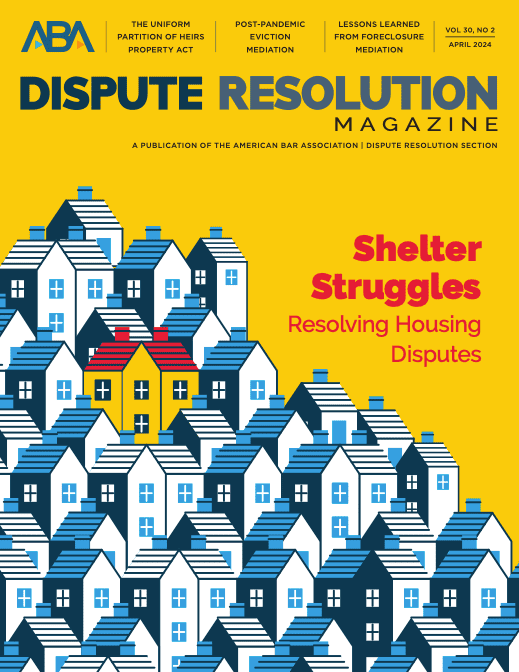
It intentionally built upon ideas presented throughout the American Bar Association’s April 2024 Dispute Resolution Magazine, which devoted an entire issue to housing conflict and eviction prevention.
Among the articles highlighted were:
- “Sustaining Eviction Mediation Efforts ‘Post Pandemic’: Out of the Courtroom and Into Public Health?” by Deanna Pantin Parrish, which examined the challenge of sustaining mediation programs after pandemic-era funding.
- “The Future of Eviction Diversion Programs” by Margaret X. Huang, which explored why eviction prevention remains valuable even when rental assistance isn’t available.
Together, these publications advanced an important national conversation.
Our goal was to take the next logical step.

Introducing HousingShield as a Sustainable Framework
Drawing on Mosaic’s experience supporting more than 850 housing disputes through the Bar Association of San Francisco Conflict Intervention Service, the article introduces HousingShield as a proactive operating model rather than simply another mediation program.
Instead of waiting until litigation becomes unavoidable, HousingShield emphasizes upstream intervention through several interconnected components:
- conflict prevention education
- shared program funding
- early access to mediation
- optional pre-mediation coaching
- flexible dispute resolution services tailored to each situation
The underlying philosophy is simple.
The earlier a conflict is addressed, the more options remain available. And most importantly, the lower the financial and human costs become.
Why Funding Matters as Much as Mediation
One of the publication’s central arguments is that successful mediation programs require more than skilled mediators.
They require sustainable infrastructure.
Many eviction diversion initiatives demonstrated remarkable success during the pandemic.
Unfortunately, many also depended on temporary funding streams.
Without reliable financial support, even highly effective programs struggle to survive long enough to produce lasting change.
Our article argues that future housing policy should prioritize funding structures capable of supporting early dispute resolution before conflict escalates.
That may include:
- public investment
- nonprofit partnerships
- private-sector participation
- subscription-style funding models like HousingShield
- blended approaches combining several funding sources
The goal isn’t simply keeping mediation programs alive.
It’s making early intervention consistently available when people need it most.
A Collaboration Across Continents
This publication also reflects something increasingly important within dispute resolution:
international collaboration.
Dr. Chinwe Egbunike-Umegbolu brings a uniquely comparative perspective to alternative dispute resolution, combining legal scholarship and practical experience across the United Kingdom, Nigeria, the Caribbean, and the United States.
As a law lecturer, researcher, published author, and internationally recognized ADR educator, her work focuses on how different legal systems approach mediation, arbitration, and access to justice.
By combining comparative legal research with Mosaic’s practical experience in housing disputes, the publication bridges academic scholarship with operational realities faced by housing providers, nonprofits, and communities throughout the United States.

From Research to Real Communities
HousingShield wasn’t created in a conference room.
It emerged from years of observing where existing systems succeed… and where they struggle.
Working alongside housing providers, nonprofit organizations, mediators, ombuds practitioners, behavioral health professionals, and public agencies has reinforced one consistent lesson:
The greatest opportunity often exists before a lawsuit is filed.
When conflict is identified early, people retain more choices.
Relationships remain repairable.
Costs stay lower.
Communities become more resilient.
That belief sits at the center of both HousingShield and this publication.
Continuing the Conversation
Publishing through the American Bar Association represents more than a professional milestone.
It reflects an opportunity to contribute practical ideas to a national conversation already being shaped by scholars, practitioners, policymakers, and community leaders.
Housing challenges will not disappear overnight.
Neither will eviction.
But by investing in sustainable early dispute resolution systems, strengthening mediation infrastructure, and continuing to share practical innovations across disciplines, communities can move closer to solutions that are more affordable, more collaborative, and more effective than litigation alone.
We hope this publication contributes one small piece to that broader effort.
Download the HousingShield Overview to see how proactive mediation can reduce eviction risk and stabilize rental housing operations.
Read the ABA Publication
