
When National Court Leaders Ask About Your Work
In January 2025, I had the privilege of presenting HousingShield’s pre-filing mediation framework to the Court ADR Committee of the American Bar Association Section of Dispute Resolution.
For me, this wasn’t simply another speaking engagement.
It represented recognition from people whose careers have been devoted to designing, evaluating, and improving mediation programs inside court systems throughout the United States.
The invitation wasn’t to speak about mediation generally.
It was specifically to explain a question many courts are now asking:
How can disputes be resolved before they ever reach the courthouse, removing the need for even filing a lawsuit?
A Conversation With Leaders Shaping Court ADR
The invitation came directly from committee co-chairs:
- Laurel Stevenson, Director of the Mediation and Assessment Program (MAP), U.S. District Court for the Western District of Missouri
- Jen Shack, Director of Research at the Resolution Systems Institute (RSI)
Together they bring more than five decades of experience studying, operating, and improving court-connected dispute resolution systems.
Laurel had learned about HousingShield during conversations throughout 2024 regarding my work in housing mediation and ombuds work at the Bar Association of San Francisco’s Conflict Intervention Service, and the subsequent dispute system design work.
Rather than simply asking for information, they invited me to present the model directly to the committee. That invitation alone spoke volumes.

Why HousingShield Was Different
Court-connected mediation has demonstrated tremendous value.
It saves judicial resources. In San Antonio’s court system, for example, it saves several million dollars in preventing “community disputes” from reaching the court when mediation is sufficient, and resolving existing cases for trial (even though many remain unaware of it).
It improves settlement rates. While difficult to undergo, the pressure of a looming trial often drives parties to think more seriously about mediation discussions, which improves settlement.
It increases participant satisfaction. Studies show that mediation improves perceived fairness of justice administration specifically through improving “procedural fairness” – that is, parties themselves see the inner workings of coming to agreement, so they are more satisfied with the outcome even when it is not what they hoped.
It often produces more durable agreements than litigation alone. It should come as no surprise that, as studies show, when parties have the freedom to forge agreements according to their many diverse interests, then those agreements would be more wholesome and longlasting.
But every court-connected mediation program shares one unavoidable limitation: The dispute has already reached the court.
HousingShield was designed to work much earlier.
Instead of asking, “How do we settle this lawsuit?”
HousingShield asks, “How do we prevent this lawsuit from becoming necessary?”
That shift—from downstream resolution to upstream prevention—formed the centerpiece of my presentation.

What the Presentation Covered
The presentation introduced HousingShield as an integrated early dispute resolution system rather than simply another mediation service.
Topics included:
- identifying conflicts before legal positions become entrenched
- education and agreement to mediate before disputes emerge
- structured pre-mediation support
- negotiation coaching
- voluntary mediation before filing
- funding mechanisms that make early intervention practical
- reducing legal costs while preserving relationships
- strengthening housing stability through collaborative problem solving
Rather than replacing courts, the model complements them.
The objective is simple: Move appropriate cases upstream while allowing courts to focus on disputes that genuinely require judicial intervention.
Sharing Lessons from the Department of Justice
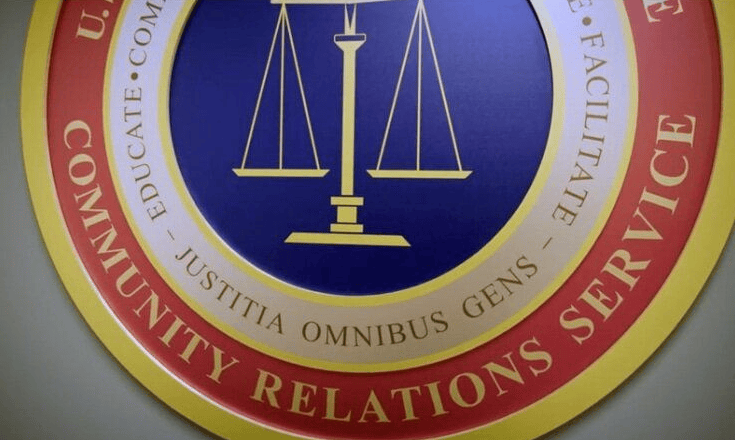
Because I had recently joined the U.S. Department of Justice Community Relations Service (CRS), committee members also asked me to discuss that work.
I shared how CRS was created during the Civil Rights Movement to help communities resolve conflicts through voluntary dialogue instead of violence.
Its principles remain remarkably consistent today. Despite the Justice Department effectively shuttering CRS in 2025, its congressional mandates remain in place.
CRS provides services that are:
- impartial
- confidential
- voluntary
- free
Using facilitation, mediation, training, and technical assistance, conciliators help communities navigate some of the country’s most difficult public conflicts.
HousingShield serves housing providers and residents, whereas CRS operates in community-wide conflicts.
Despite the difference in scale, both share the same underlying philosophy: Invest in and leverage relationships for negotiated, dialogue-based agreements whenever possible, especially proactively.
For HousingShield, that means keeping roofs overhead and business bottom lines intact; for CRS, that means preventing violence, restoring voluntary compliance with the law, and forging community-based agreements to resolve widespread group-level disputes.

Court ADR and Pre-filing Mediation: Partners, Not Competitors
One misconception I frequently encounter is that expanding pre-filing mediation somehow competes with court mediation. For HousingShield, this couldn’t be further from the truth.
The two systems serve different moments along the conflict timeline.
Conflict typically progresses something like this:
Conflict emerges → communication deteriorates → legal positions harden → lawsuit filed
→ court mediation → trial (if necessary)
HousingShield simply creates another intervention point near the beginning of that timeline, and supports the conditions that enable parties to come willingly early on (and do so prepared).
When successful, everyone benefits:
- parties save money
- courts receive fewer avoidable filings
- attorneys can focus on higher-value matters
- relationships have a better chance of surviving
Rather than replacing court ADR, early dispute resolution strengthens the entire dispute resolution ecosystem.

Validation Beyond a Single Presentation
The January presentation marked the beginning of an ongoing conversation.
Over the following months, committee members continued discussing opportunities for expanding pre-filing mediation. Those conversations eventually grew into something even more significant.
In late 2025, leadership from the Resolution Systems Institute (RSI) invited me to participate as a collaborative partner on a grant proposal submitted to the Illinois Supreme Court Access to Justice Commission, submitted in March, 2026.
The proposal sought to expand housing mediation beyond traditional court-connected programs by incorporating concepts drawn from the HousingShield framework. The grant proposal was simple: if the court granted “seed” funding for a local instance (“HousingShield Chicago”), Mosaic would launch the required educational campaign that would lead to landlord-tenant registrations, generated fees would support the program long-term, and RSI would serve as the fiscal agent and performance evaluation partner to ensure funds were used appropriately and effectively.
Although the grant was ultimately not funded, the invitation itself represented meaningful validation.
Organizations whose mission is researching and improving court-connected mediation believed HousingShield contained ideas worth exploring at a statewide systems level.
That level of engagement says far more than any marketing claim ever could. Beyond having leaders in the field believe in HousingShield, it was moving to understand why.
RSI Executive Director, Heather Fogg, recounted previous efforts in the Aurora and Kane County area, which established a strong consensus among stakeholders (including landlords, tenants, and local advocacy groups) that a pre-filing early intervention program was the optimal approach for resolving landlord-tenant disputes. It was telling that the multi-stakeholder group arrived at the same conclusion on their own, without ever hearing of HousingShield (much less a pitch for it).
However, these initiatives stalled primarily due to a lack of dedicated funding. The collaboration between Mosaic and the Resolution Systems Institute (RSI) thus positioned HousingShield as the key to continuing these efforts, utilizing a self-sustaining, stakeholder-funded model to overcome historical financial barriers and secure seed funding for a pilot program.

Building on a Broader National Conversation
The presentation also fit within a much larger discussion taking place throughout the dispute resolution profession.
Following the American Bar Association’s growing emphasis on Early Dispute Resolution (EDR) and publications focused on housing stability, many practitioners have begun asking how mediation can move beyond reacting to disputes.
HousingShield contributes to that conversation by combining lessons from multiple environments:
- hundreds of housing disputes through the Bar Association of San Francisco’s Conflict Intervention Service
- volunteer mediation inside Texas Dispute Resolution Centers (Central Texas; Bexar County)
- ombuds principles
- business systems consulting
- housing operations
- negotiation coaching
- public dispute resolution
Instead of viewing mediation as a single event, HousingShield views it as one component within a larger conflict management system.

Why This Matters for Housing Providers
For landlords, property managers, and housing organizations, every dispute carries hidden costs that can extend far beyond legal fees.
- Legal fees from retainers, filings, and even if recovery happens, the costs to dismiss actions
- Vacancy rates and vacancy loss
- Unit turnover and lower occupancy rates
- Staff time lost to disputes (and unnecessary releasing)
- Damaged relationships
- Gross Potential Rent that builds as units sit empty across portfolios
- Loss to lease: concessions given to fill units after they’ve been sitting idly too long– one, two, even three months of free rent.
Many of these costs begin accumulating long before anyone files paperwork with the court.
That makes prevention one of the highest-return investments available.
The earlier communication improves, the more options remain available.
Once litigation begins, those options narrow quickly, and the psychology becomes increasingly “winner take all.”

Why This Matters for Courts
Courts across the country continue facing increasing caseloads and limited resources.
Court-connected mediation has become one of the judiciary’s most successful innovations over the past several decades.
Pre-filing mediation represents the next logical evolution.
If appropriate disputes can be resolved before filing, courts gain additional capacity to focus on matters requiring judicial determination while communities gain faster, less expensive pathways toward resolution.
The future of dispute resolution is unlikely to be either litigation or mediation.
It will increasingly involve designing systems that help people access the right process at the right time.

Looking Ahead
One of the most rewarding aspects of presenting before the ABA Court ADR Committee wasn’t simply discussing HousingShield.
It was participating in a conversation shared by judges, court administrators, researchers, mediators, attorneys, ombuds, and policymakers across the country:
How do we build justice systems that prevent unnecessary conflict instead of merely processing it?
My work has been built on the tremendous careers and insights of many leaders in the few. These include, just to name a few, Roger Moss who founded the Conflict Intervention Service program of San Francisco; Former Judge Doug Mintz and his work in foreclosure diversion in Connecticut; Ellie Vilendrer and Felicia Harris Hoss in driving the recognition of Early Dispute Resolution as best practice, and many more.
That question continues to guide my work today, and the work of these leaders help me to offer my own meaningful contributions.
Whether through HousingShield, consulting, mediation, organizational design, or public service, the goal remains the same:
Help people resolve conflict earlier, preserve relationships whenever possible, and create systems that become stronger because they learn from conflict rather than merely reacting to it.
Key Takeaways
- Invited by the ABA Court ADR Committee to present HousingShield’s pre-filing mediation framework.
- Shared how early dispute resolution complements (not replaces) court-connected mediation.
- Discussed lessons from both HousingShield and the U.S. Department of Justice Community Relations Service.
- Continued collaboration with national ADR leaders ultimately led to participation in an Illinois Supreme Court Access to Justice grant proposal exploring expansion of pre-filing housing mediation.
- Demonstrates national recognition of HousingShield as an innovative contribution to dispute system design.
Continue Exploring
If you’re interested in building dispute resolution systems that reduce legal costs while strengthening relationships, you may also enjoy:
- HousingShield: Pre-Filing Mediation for Housing Providers
- Mediating Along the I-35 Corridor: Resolving Conflict Before and After Court in Central Texas
- ABA Publication: Advancing Eviction Mediation Through HousingShield
- Before HousingShield: Inspirational Origins in San Francisco’s CIS Program
- Schedule a Discovery Call to discuss dispute system design for your organization.
