
During a webinar hosted by the UTSA Small Business Development Center, Alec Chapa explored how mediation, early intervention, and proactive dispute resolution can help landlords reduce costs, preserve occupancy, and avoid unnecessary eviction filings.

Evictions Are Awful, Not Inevitable
Evictions… they feel dreadful for everyone involved, and when things go from bad to worse, unavoidable. A little like a natural disaster. The same story plays out, over and over.
Tenant stops paying rent.
Notice to vacate served.
Case filed.
Unit turnover.
Business moves on.
Or does it?
After handling hundreds of housing disputes all over the country, working with leading attorneys and judges in the ABA, and comparing innovative solutions, Alec Chapa presents a clear message to providers:
Eviction is awful, it costs you far more than they realize, but there’s a much better way. Even if some attorneys don’t want you to know.
Beginning in September 2024, Alec began spreading this wisdom, presenting webinars for the University of Texas at San Antonio Small Business Development Center and beyond. The aim? Share best practices that have become increasingly important for landlords, property managers, and real estate investors:
Proactive Asset Management for Landlords.
How Much Is Eviction Costing Your Rentals? Growing Pressures Up the Risks
The audience included independent landlords, owner-operators, property managers, and housing providers seeking practical ways to improve operations, reduce risk, and protect the financial performance of their rental properties.
Rather than beginning with legal procedures or property management tactics, Alec started with a more fundamental question:
What is an eviction really costing you?
The answer, he argued, is often much larger than landlords expect.
Even a single eviction can easily cost thousands of dollars once lost rent, vacancy, turnover expenses, legal fees, staff time, maintenance, and operational disruptions are considered. This itemized breakdown shows how in many situations, the financial impact can consume a substantial portion of a unit’s annual income.
See Your Financial Exposure
And the risks are growing.
With housing affordability challenges affecting communities throughout Texas and across the country, more renters are living on financial margins than ever before. Rising housing costs, inflationary pressures, energy costs, and broader economic uncertainty have increased the likelihood that many housing disputes will eventually become lawsuits (even when they shouldn’t).
From Downstream Court Disruption to Upstream Early Intervention

The financial reality creates challenges not only for residents, but also for housing providers trying to maintain stable operations and predictable cash flow.
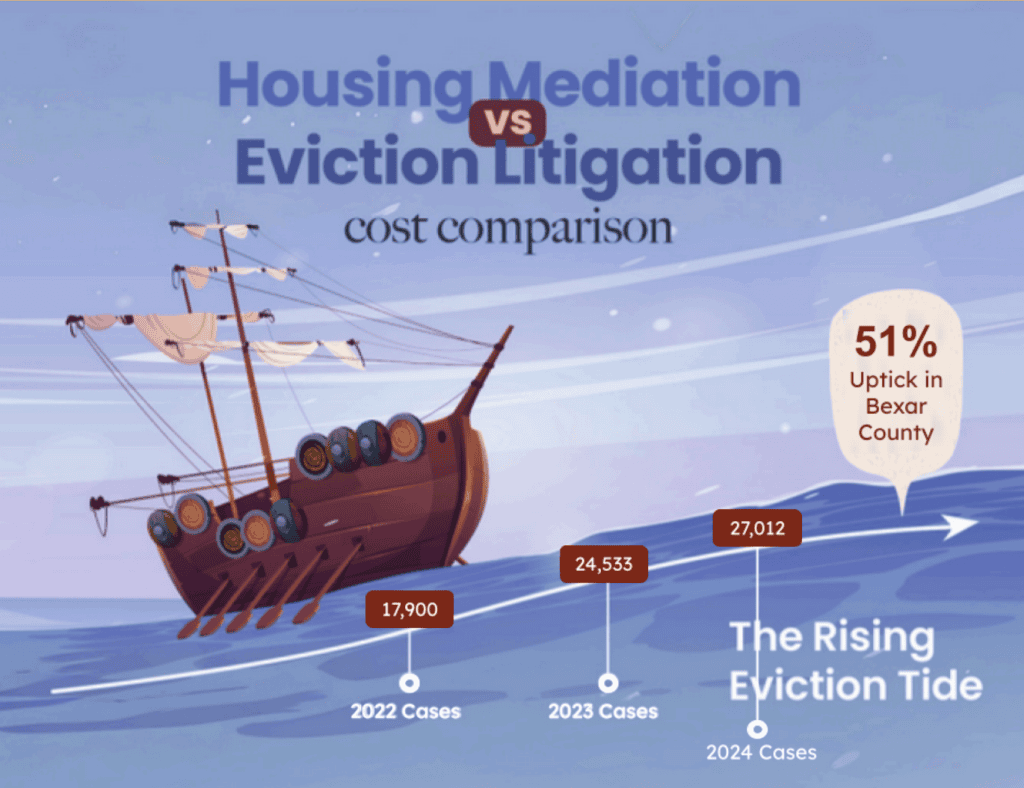
“Since 2022, the numbers have only gone up — dramatically,” Alec explained during the presentation. “We’re up 51% in Bexar County, and that’s because we’re the most affordable major city in Texas.”
After a sobering outlook, he turned to solutions with actionable takeaways.
Drawing from both research and real-world experience, Alec introduced participants to the growing body of evidence supporting early intervention and mediation as effective tools for addressing landlord-tenant disputes before they escalate into formal legal proceedings.
He highlighted how eviction diversion and mediation programs demonstrated measurable success across 300,000+ Texas households during COVID, and discussed the growing recognition of Early Dispute Resolution as a best practice within the legal and dispute resolution communities.
Participants were then guided through a practical workflow showing how mediation can be integrated into rental operations before conflicts become lawsuits.
Several real case studies illustrated the approach in action.
In one example, mediation helped preserve a tenancy that otherwise seemed destined for eviction.
In another, the parties reached a mutually acceptable agreement in which the resident, having suffered severe domestic issues, transitioned out of the property without the financial and emotional costs typically associated with contested legal proceedings. And no eviction on her record to haunt her future rental applications.
These examples underscored a central theme of the presentation:
The greatest financial savings nearly always occur before legal action begins.

Proactive & Prepared Long Before a Rental Crisis Hits
Leading with this key insight, Alec encouraged a strategic shift in provider thinking: rather than viewing mediation solely as a response to conflict, think of dispute resolution as a proactive asset management strategy and system, established long before it’s needed.
Mediation can help address common landlord-tenant issues like nonpayment, lease disputes, communication breakdowns, as well as roommate conflicts and neighbor disputes while keeping solutions manageable and relatively inexpensive.
For landlords wondering how to resolve landlord tenant disputes without court, when a landlord should use mediation, or how property managers can resolve tenant disputes early, the answer is often the same:
The sooner intervention occurs, the greater the opportunity for positive outcomes.
Alec also emphasized that mediation is not simply about avoiding lawsuits.
It is about protecting occupancy, preserving resident relationships when possible, reducing operational burdens, and stabilizing cash flow in an increasingly uncertain environment.
Aside from uplifting providers and residents with recovery opportunities, early intervention also supports broader community prosperity.

Yesterday’s Common Sense, Today’s Business Woes
“Ordinarily, common sense would outline a clear management strategy: screen and avoid risky tenants, prevent issues, handle nonpayment as needed with eviction,” he explained.
“But these are different times.”
With half of renters considered cost-burdened across the state, housing providers face a level of systemic risk that traditional property management approaches were never designed to address on their own.
That is where dispute resolution creates new, early intervention opportunities.
While providers cannot control inflation, economic conditions, or housing supply shortages, they can influence how conflicts are managed when challenges arise.
And sometimes, resolving a dispute before it reaches a courthouse can be one of the most profitable decisions a housing provider makes. Especially when they are used to paying out court and attorney fees—then they see the drastic savings from replacing those line items with mediation.
… Maybe that’s why some lawyers jokingly refer to Alternative Dispute Resolution (ADR) as Alarming Drop in Revenue.
As founder of Mosaic Collaborative Consulting, Alec has spent years working at the intersection of housing stability, mediation, landlord-tenant conflict, and early dispute resolution. His work has supported hundreds of housing-related cases and reflects a broader belief that conflict, when addressed early and effectively, can often become an opportunity for problem-solving rather than a pathway to litigation.
For landlords, property managers, and housing leaders navigating today’s increasingly complex environment, that distinction may matter more than ever.
Parting with actionable insights, Alec also shared a free resource: a calculator specifically designed with San Antonio in mind. His parting message?
Stop guessing. Start preparing. Calculating your financial exposure is the bare minimum you should be doing to stave off disaster. If you’re a small owner-operator, at least run the numbers to know you have enough for a rainy day. The imperative is even greater for bigger providers.
Watch the Recording: Proactive Asset Management for Landlords
