From business disputes to landlord-tenant conflicts, volunteering with the Central Texas Dispute Resolution Center has strengthened access to justice while shaping new ideas for proactive conflict resolution.

Building Mediation Capacity in One of Texas’ Fastest-Growing Regions
Building Mediation Capacity in One of Texas’ Fastest-Growing Regions
Growth creates opportunity.
It also creates conflict.
Communities along the Interstate 35 corridor, including New Braunfels, San Marcos, Seguin, Kyle, Buda, Lockhart, Canyon Lake, and surrounding areas, have experienced tremendous population growth over the past decade. Adding San Antonio and Austin, the region is home to over 5 million people, and projected to grow to 8+ million by 2050. Alongside new homes, businesses, and development inevitably come disagreements between neighbors, landlords and tenants, businesses and consumers, families, and organizations.
For the past three years, Mosaic Collaborative Consulting Founder Alec Chapa has volunteered as a mediator with the Central Texas Dispute Resolution Center (CTDRC), helping individuals and organizations resolve those conflicts through mediation rather than prolonged litigation. This work complemented similar work inside Bexar County’s mediation system, making for deeper insights into several systems at once. Alongside this local work, Alec also served as a Conciliator for Community Relations Service (CRS), the mediation component of the U. S. Department of Justice.
Serving Comal, Guadalupe, Hays, and Caldwell Counties, the Center provides an important public service that expands access to justice while reducing pressure on already busy court systems.
A Reputation That Led to an Invitation
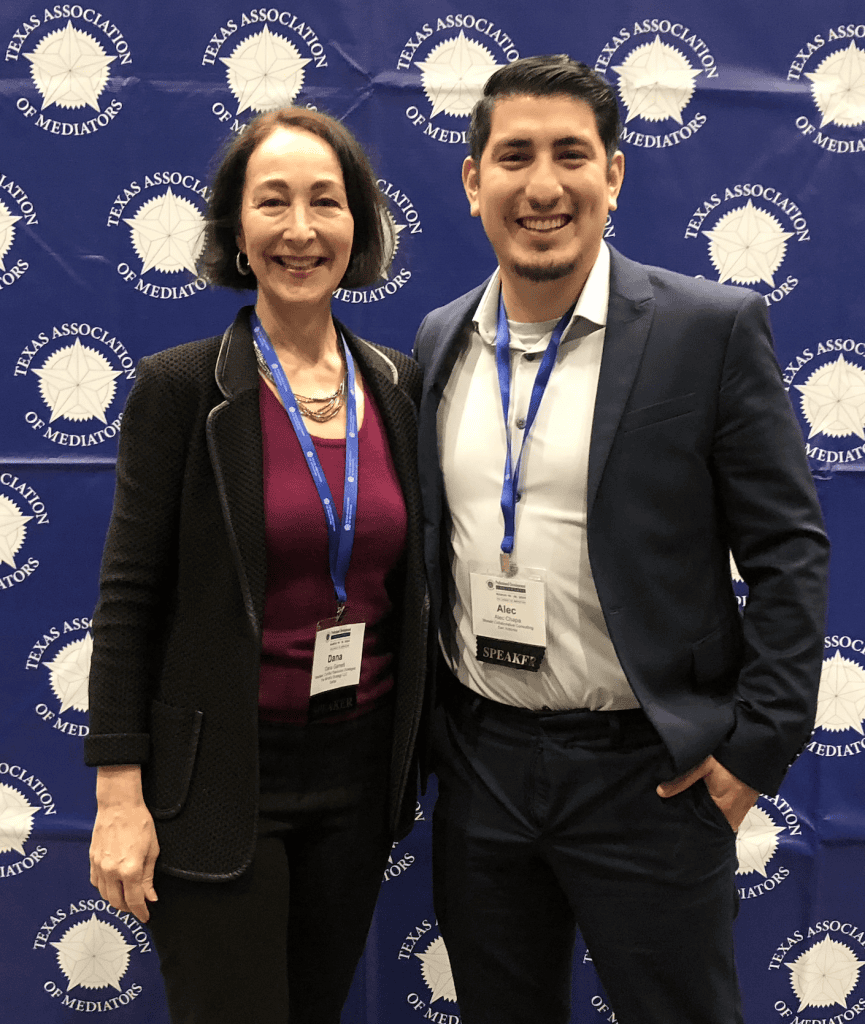
Alec joined CTDRC in July 2023 following a recommendation from Board Vice President Gary Graning and approval by Executive Director Martha Joyce.
By that point, Alec had already established a growing reputation in the dispute resolution community through:
- serving hundreds of housing cases with the Bar Association of San Francisco’s Conflict Intervention Service,
- being selected as an American Bar Association Dispute Resolution Fellow,
- speaking and publishing on mediation, conflict resolution and systems design, and
- building Mosaic Collaborative Consulting around practical, interdisciplinary conflict resolution.
After meeting through the Texas mediation community, Gary extended a personal invitation to volunteer with the Center.
Following interviews and orientation, Alec began accepting cases across the region.
Resolving Both Community Conflicts and Court Cases
One aspect that makes CTDRC especially valuable is the variety of disputes it handles.
Some cases arrive before litigation, often referred to as community mediation.
Others come after a lawsuit has already been filed, with judges referring parties to mediation before trial.
Over the past three years, Alec has assisted with disputes involving:
- landlord-tenant disagreements
- eviction-related matters
- Domestic violence housing cases
- neighborhood conflicts
- HOA disputes
- breach of contract claims
- unpaid invoices
- consumer-business disagreements
- other civil disputes
Housing and business conflicts together represent nearly half of the Center’s mediation work, making them especially important areas for both the local economy and community stability.

Why This Experience Matters
Court-connected mediation works.
Every day, people avoid costly trials because they reach agreements through mediation.
But volunteering in the status quo system also revealed something larger.
Many disputes follow a familiar path:
- Conflict emerges > communication breaks down > dysfunction worsens
- Nobody intervenes early > the issue escalates > a lawsuit is filed
- Months later, the parties finally sit down in mediation.
- The end result? You guessed it. Most cases (65-80%) settle.
While successful, that status quo still consumes significant time, money, stress, and court resources.
That observation became one of several experiences helping shape Mosaic’s thinking around HousingShield and proactive dispute resolution.
At the same time as Alec was observing the spent resources of court-referred “downstream” cases, he was also early-intervention housing of cases in San Francisco, available as soon as cases emerged. The contrast couldn’t be more apparent.
The question became:
What if more of these cases entered mediation before anyone filed suit?

From Court Mediation to HousingShield
One landlord-tenant mediation illustrates that opportunity particularly well.
Following a successful mediation, representatives from Kashmir Properties asked Alec to meet with them to learn more about the dispute resolution landscape. Their search was fueled by rising cases over the years, and experimenting to find the best approach to managing real estate investment risks.
The court represented their last resort. “We’ve tried everything. Working with tenants on payment plans, debt collections… This time, we were determined to ‘go all the way’ with the court process.”
After the judge mandated mediation before they could even get a trial date, they quickly recognized something many housing providers realize the hard way:
Mediation was inevitable… but that wasn’t a bad thing because the dispute ultimately settled through mediation anyway.
The lawsuit had simply added months of expense, uncertainty, and administrative burden. Shifting to a proactive, mediation-first response reduces legal and turnover costs 30-50% vs waiting and litigating.
Those conversations eventually led Kashmir Properties to become a HousingShield client, adding more than 85 housing units to proactive mediation coverage.
That experience reinforces an important distinction:
HousingShield doesn’t compete with community mediation programs; it expands mediation by reaching people who almost certainly never receive services otherwise.
In just this region of Texas, thousands of residents seek mediation each year, yet only a fraction ultimately participate.
Creating pathways into mediation earlier increases—not decreases—the number of disputes resolved collaboratively. HousingShield’s mediate-first approach still enables parties to go to other providers when needed; the real shift is in educating parties on mediation and securing agreement to mediate before crisis, not after it occurs (and escalates to the court).

Supporting Access to Justice Across Central Texas
Organizations like CTDRC play an essential role in communities throughout Central Texas.
Supported by partners including the McKenna Foundation and Frost Bank, the Center provides affordable dispute resolution while also helping develop the next generation of mediators through practical volunteering experience, which Mosaic seeks to build on using additional structured experiential learning.
As Central Texas continues growing, infrastructure for justice must grow alongside it.
Roads, utilities, and housing are only some pieces of a healthy community.
Communities also need trusted systems for resolving inevitable disagreements before they become expensive legal battles.
That mission aligns closely with Mosaic’s own commitment to expanding access to practical, collaborative dispute resolution throughout Texas, and HousingShield’s mission to make it easy, fast and affordable for people to access mediation where it has an outsized impact: right at home.
Looking Ahead
Three years of volunteer mediation has strengthened more than Alec’s own professional development.
It has deepened relationships throughout the Texas mediation community, strengthened partnerships across the I-35 corridor, and generated practical insights that continue shaping Mosaic’s work in housing stability, business conflict resolution, and early dispute resolution.
Whether through nonprofit mediation centers, HousingShield, or community partnerships, the goal remains the same:
Help people resolve conflict sooner, preserve relationships where possible, and create stronger communities through better systems for managing disagreement.
Download Executive Director Martha Joyce’s recommendation letter to learn why CTDRC recognized Alec’s service as a volunteer mediator.
New help now? Start with a free consult.
Learn about upstream, proactive mediation for housing providers and residents
