At a monthly meeting of the Alamo PMI Chapter, Alec Chapa shared best practices & case-driven insights on how dispute resolution helps project managers mitigate risk, protect budgets, strengthen teams, and improve project outcomes in an increasingly uncertain world.
Updated: May 30, 2026
By Alec Chapa

Project managers spend significant time planning for risk. Minor ones, major ones, and most definitely the ones that can kill projects altogether.
They identify potential threats, evaluate probabilities, estimate impacts, develop response strategies, and create contingency plans designed to keep projects on track when uncertainty inevitably emerges.
But there is one category of risk that often receives less attention than it deserves:
Conflict.
Whether it arises between team members, stakeholders, customers, vendors, executives, sponsors, or external partners, unresolved conflict has the potential to derail timelines, inflate budgets, damage morale, and create legal liabilities that threaten project success. That’s what makes conflict resolution for project managers so critical.
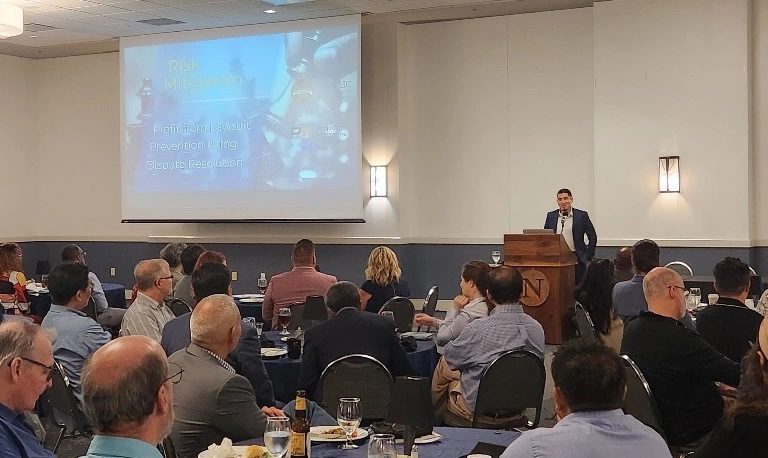
Alec Chapa presented this during the May 2024 monthly member meeting hosted by the Alamo PMI Chapter at the Norris Conference Center.
The Risk Management Fundamentals Every PM Must Know
Introduced by then chapter president Everet Taylor, Alec spoke with project managers representing a wide range of industries about how dispute resolution can serve as a powerful risk mitigation strategy before conflicts escalate into costly operational, organizational, or legal problems.
The presentation began with a review of risk management fundamentals familiar to most project management professionals.
Risk is inevitable.
Projects rarely unfold exactly as planned.
And successful project leaders recognize that uncertainty must be managed proactively rather than reactively, whenever possible.
And when surprise disruption happens, they must know the rapid response methods they can use to neutralize issues and keep them from spreading.

Two Case Studies: Customer Lawsuit & Sudden Personnel Loss
From there, Alec explored when risk mitigation is appropriate, how different categories of risk require different response strategies, and why interpersonal and organizational conflict deserve greater attention within project planning frameworks.
To illustrate these concepts, he shared several real-world case studies from his own professional experience.
One involved a roofing company facing a customer dispute that escalated to litigation. Through mediation, the parties were able to resolve the conflict without the costs, delays, and uncertainty often associated with court proceedings. $10,000 in damages sought by the customer avoided, while still delivering a meaningful resolution to the customer, thanks to mediation discovering a third pathway, escaping the win-lose dynamic.
Another case involved a software implementation project where disagreements emerged between a project sponsor and project manager following the sudden loss of an internal technical leader. Acting as an intermediary between internal and external technical experts and organizational leadership, the project manager facilitated discovery, clarified competing perspectives and potential options for resolution, and ultimately helped guide a successful system rebuild that resolved the conflict while preserving funder and client relationships.

Conflict Isn’t the Threat;
It’s Conflict Mismanagement
While the industries and circumstances differed, both examples demonstrated a common lesson:
Conflict itself is not necessarily the threat.
The greater threat is allowing conflict to remain mismanaged or neglected altogether.
Building on those examples, Alec then explored the dispute resolution methods most relevant to project managers, including:
- Negotiation, enabling team effectiveness
- Mediation, leveraging an outside neutral for added conflict capacity
- Arbitration, producing binding and final outcomes
- Expert Neutral Evaluation, perfect for highly technical and specialized matters
- Facilitated Dialogue, guiding collaborations so teams can focus on substance and decisions
- Skill-Building, improving communication and collaboration before disputes escalate
Participants also reviewed research supporting alternative dispute resolution processes, practical techniques project managers can apply immediately when conflict emerges, and strategies for designing projects that proactively incorporate dispute resolution mechanisms from the outset.
The beauty of dispute resolution is that it runs the full spectrum of responses, both preventative and responsive
“The beauty of dispute resolution is that it runs the full spectrum of responses, both preventative and responsive” Alec explained. “If a dispute erupts and even escalates to a lawsuit with a trial date set, these methods can resolve the matter with a binding agreement and lawsuit dismissal. They can also help you prepare for success by integrating these practices into bylaws, operating agreements, project charters, and SOPs. Either way, these methods can adapt to the needs of you, your team, and your project, no matter how unique.”

Uncertainty & Volatility Stoke Conflict, Demands Capable Conflict Resolution
The topic was especially relevant in 2024 as organizations across industries faced ongoing inflation pressures, budget constraints, staffing challenges, and heightened uncertainty.
Over the last two years since then, the conversation feels even more timely.
From supply chain disruptions and geopolitical instability to shifting regulatory environments and economic volatility, today’s organizations operate in a landscape where resilience has become a competitive advantage.
The ability to identify, manage, and resolve conflict effectively is no longer simply a leadership skill.
Conflict management is increasingly a project success skill. When leaders have it, they can prevent train wrecks and save at-risk projects; when they don’t, it can spell out the end for them.

Today’s Leadership Demands Competent Conflict Management
As both a Project Management Professional (PMP) and SHRM Certified Professional (SHRM-CP), Alec brings a multidisciplinary perspective that bridges project management, organizational leadership, human dynamics, and dispute resolution. His work around the country continues to explore how conflict resolution can move beyond reactive problem-solving and become a strategic capability that strengthens projects, organizations, and communities alike.
For project managers, the lesson is straightforward:
Risk management is not only about preventing and recovering from technical failures.
It’s also about orchestrating processes that contain and redirect the raw energy of conflict, towards productive conversations, restoring trust, and building solutions.
The best teams are not just technically capable, and synergized on good days; they are resilient enough to persist through tough times, especially with today’s uncertainty and volatility.
The project leaders are their backbone. They must be ready to engage conflict head-on: levelheaded, collaborative, and equipped with best practices.
Couldn’t attend?
Email us for a copy of the slides
Want Mosaic to speak at your event?
Contact us and we’d love to discuss.
—
Written with the help of A.I.
